Thematic Areas
The concept of human rights is traced to the United Nations Universal Declaration of Human Rights (UNDHR). It is an international document adopted by the UN General Assembly in 1948 enshrining the rights and freedoms of all human beings. Its adoption followed the events of the Second World War that profoundly shocked and horrified the entire human race. These ugly events forced world leaders to turn their attention and energy toward establishing a new world order in which the rights of every individual or group would be respected. These are the basic rights and freedoms in which every human being could lay claims, as a right, to a minimum standard of treatment both from other individuals and from their government.
- RULE OF LAW: The concept presupposes that the rule of law is supreme over governmental action and individual behaviour. It means that leaders must hold themselves to the same rules and the same restraints and never to act above the rules.
It also means that leaders must ensure that the rules are respected and must guaranty the protection of the rights of citizens and their property, subject the government and its agencies to respect court orders. In practice, this is not always the case with government officials. It is usually the rule of the thumb rather than the rule of law, as court orders are disrespected with impunity, extrajudicial killings take place, and no compensations are made when such violations take place. It is against this backdrop that citizens need to be aware and educated on the concept by way of advocacy for them to know and realize their fundamental rights and hold governments accountable. - POLITICAL AND CIVIL RIGHTS: These are the rights guaranteed for individuals to participate in political and civil activities of their nation state without fear of discrimination, intimidation or repression. These rights include the right to fair trial, right to seek redress in a court of law, right to participate in politics and the right to freedom by association and assembly. However these ideals are becoming more difficult to attain given the weak and failing democratic institutions, endemic election irregularities, lack of confidence in the election body, the intractable election related violence, vote buying, intimidation of election officials and voters, low representation of women in decision – making institutions like the legislatures, etc. Certainly, these problems hinder citizens of their political and civil rights; hence, the imperativeness of continuous advocacy.
- ECONOMIC RIGHTS: Mass poverty is stark and endemic on the land and as a result, there is mass rural – urban drift especially by young people in search for better life. But they soon realize that the cities are not any better. They are then caught up in this dangerous situation and most are left with no better option than go into forced labour in the cities where the girls are thereafter molested sexually or trafficked to other cities or across national boundaries or Europe for prostitution. Others are engaged in debt bondage and are poorly and unfairly paid. This violates not only International Labour laws but equally their rights to their dignity of their persons and the right to fair entitlements. The need for advocacy in this area is huge, especially in trafficking in persons, if it must be prevented right from our local areas to the cities.
- RIGHT TO EDUCATION: Under Chapter Two of Nigeria’s 1999 Constitution, education is made free and compulsory in Primary, Secondary, University and Adult Literacy Programme levels. The reality is that education is not free at any of these levels. Parents pay heavily for their wards as school fees. Schools are shut down by incessant strikes by school teachers in primary to the University because of government’s neglect and abandonment. As a consequence, students are thrown out of schools and are influenced to join criminal gangs who engage in kidnappings, armed robberies, thefts, rapes, illicit drugs and other crimes which have fuelled the already insecure environment.About three million children in the north were left without access to school as a result of insurgency. This violates the constitution and Article 26 of the UNDHR to which Nigeria is a signatory.
- HEALTH CARE RIGHTS: Health Care rights include the ability of citizens to have access to adequate health care facilities and services. This is determined by appropriate Government’s social and economic policies that make health care services available, affordable and sustainable. Health care being a wholistic system, it works in partnership with adequate food, water, sanitation, safe working conditions, housing and the eradication of poverty. The right to health care is a fundamental part of human rights and is recognized under the 1966 International Covenant on Economic, Social and Cultural rights. Advocacy is needed in this sector as the right of citizens is denied because of the inadequate availability of health facilities and poor health services.
- FREEDOM OF SPEECH, EXPRESSION, AND PRESS: This principle guarantees the freedom of an individual, group of individuals or a community to articulate their opinion and ideas without fear of retaliations, censorship or legal sanction from authorities. The right includes not only to hold ideas without interference, but even under this international framework, free speech, expression and the press is being gagged with several unnecessary media laws. A number of journalists have been arrested and detained for publishing “false and damaging” information, individuals are also not spared for social media comments or are charged for blasphemy while government came out with a Bill (proposed law) on Hate Speech and on dissemination of false statement, media houses fined or closed down. An environment such as this does not guarantee the freedom whereby issues of significant national importance are discussed robustly or debated to promote democracy.
- WOMEN AND GENDER EQUALITY: Women and girls suffer underserved violence in form of discrimination. Some of this discrimination includes early and forced marriage, male child preference, preference for male-child education, acid violence, female genital nullification, (FGM) marriage by abduction or by rape, corrective rape, widowhood rituals accusation of witchcraft, nutritional taboos, wife battery. One of the notorious areas of discrimination or violence is the denial of women the right to inherit land from their parents or husbands. Advocacy would require teaching the men to ensure equality and fairplay among their children at home, showing respect and honour to wives and mothers, prohibiting gender inequality and harmful traditional practices in the community and sanctioning violators of women’s rights, etc. There’s still along way to achieving gender equality.
- CHILD RIGHT: The UN Convention on the rights of the child protects childhood and guarantees the child special care from conception to birth. Nigeria’s Child rights Act and the Child Rights laws of the various states guarantee same protections for the child. The principle behind it is to enable the family provide a caring environment that would protect the child as he or she grows up to value liberty, freedom, and equality. This is another area for rights activists.
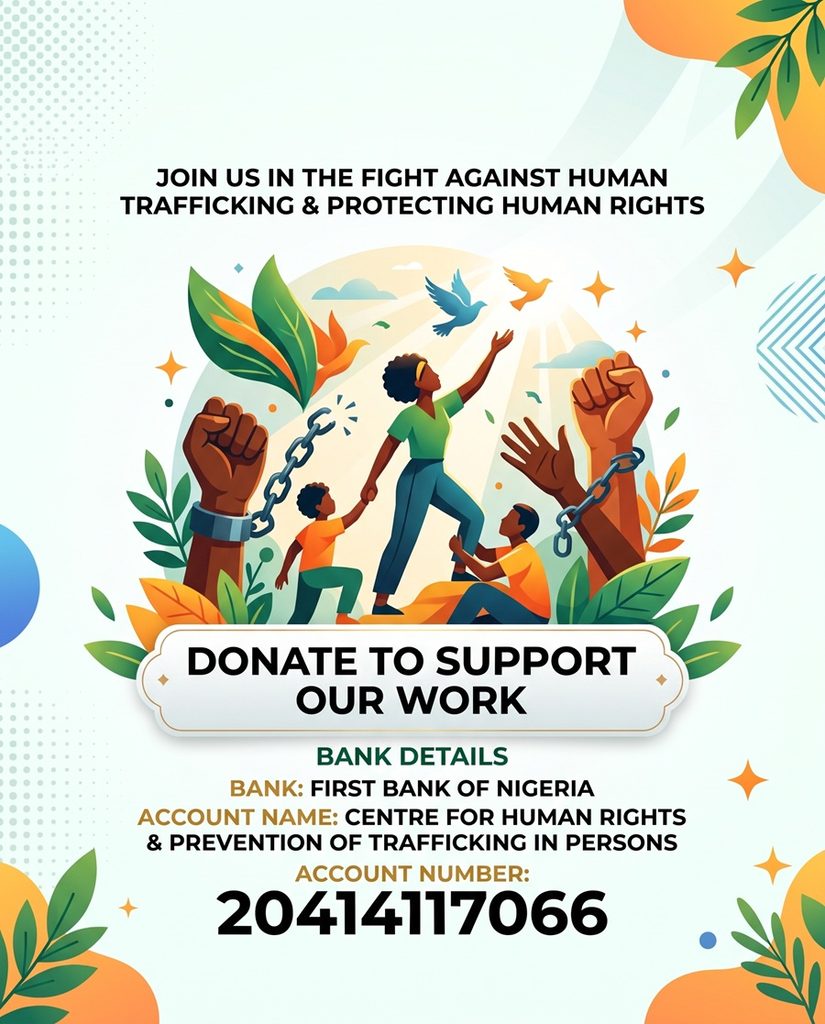
- TRAFFICKING PERSONS: Trafficking in persons or human trafficking is an organized criminal behavior. The traffickers employ certain methods to perpetuate the crime. This includes recruitment, transportation and exploitation and they control this through violence or threats of violence, deception, imprisonment, collusion, debt bondage, isolation, etc. In the process of committing these crimes, the human rights of the victims is violated, his personality is degraded and dehumanized and his health is put at risk. These acts happen around us in a daily basis, from our villages to the cities.
- RELIGIOUS RIGHTS: This right allows every person to freely choose, practice, change, or renounce a religion, either alone or with others, in public or private. It is protected under Section 38 of Nigeria’s Constitution and Article 18 of the UNDHR. In Nigeria, this right is threatened by religiously motivated violence, attacks on churches and mosques, discriminatory local policies, and social persecution of converts. Advocacy requires promoting interfaith dialogue, documenting violations, engaging religious leaders, and holding government accountable for protecting everyone’s right to worship safely.